Showing posts with label housing. Show all posts

Thursday, July 12, 2012

Is the housing bust over?


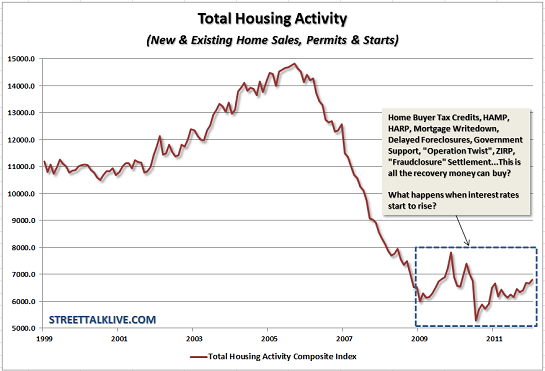
The numbers would indicate so.
Nearly seven years after the housing bubble burst, most indexes of house prices are bending up. "We finally saw some rising home prices," S&P's David Blitzer said a few weeks ago as he reported the first monthly increase in the slow-moving S&P/Case-Shiller house-price data after seven months of declines.
Nearly 10% more existing homes were sold in May than in the same month a year earlier, many purchased by investors who plan to rent them for now and sell them later, an important sign of an inflection point. In something of a surprise, the inventory of existing homes for sale has fallen close to the normal level of six months' worth despite all the foreclosed homes that lenders own. The fraction of homes that are vacant is at its lowest level since 2006.
The reduced inventory of unsold homes is key, says Mark Fleming, chief economist at CoreLogic, a housing data-analysis firm. For the past couple of years, house prices have risen in the spring and then slumped; the declining supply of houses for sale is reason to believe that won't happen again this year, he says.

Tuesday, April 24, 2012

A man's home is his noose

A strong case can be made that the fundamental supports of the housing market-- demographics, employment, creditworthiness and income--will not recover for a generation, Charles Hughes Smith writes.
 It can even be argued that housing has lost its status as the foundation of middle class wealth, not for a generation, but for the long term.
Blame it on the Baby Boom.
We can stipulate that the Baby Boom (65 million people) will be downsizing their housing, i.e. selling for the next two decades. We can also stipulate that most of the Baby Boom no longer has the wherewithal to buy second homes; rather, they will be dumping second homes to pay for living expenses as earnings, interest income and housing equity have all cratered since 2007. 
Not only are there not enough younger workers to buy all these millions of homes that will be put on the market, few of those younger workers have either the creditworthiness or income to buy a house unless the Federal government gives them essentially free money and a no-down payment entry. With the Federal deficit skyrocketing, that sort of giveaway won't last long.
You might want to close your eyes here.


Meantime, people are trapped where they are by the lousy housing market.
Nearly 60 percent of Americans would move from their communities right now if they could, according to a new survey by the YMCA. But with economic and other financial considerations preventing them from doing so, nearly two-thirds said they will become more involved in their community in the coming year in hopes of improving quality of life.
It's not pretty out there.

Sunday, February 27, 2011

Signs of a better housing market?

Depends on where you live, M.P. McQueen reports in The Wall Street Journal.

The key to understanding this is that there really isn't one big national market for houses, but rather thousands of smaller markets. What's happening in your state or town or even in parts of your town can differ from what's happening elsewhere.
The national housing market is merely a collection of local markets. And while those markets have moved together to an unusual degree during the past 15 years or so, new data show that the pattern is changing—and that many markets are safer now than they have been in years. 
In the first quarter of 2009, for example, median prices for existing-home sales declined from the previous year in 134 of 152 metropolitan statistical areas, according to the National Association of Realtors. By contrast, in the fourth quarter of 2010, median prices rose in 78 markets, fell in 71, and were unchanged in three.
Local Market Monitor Inc., a real-estate research company that ranks local housing markets, akes repeat-sales prices compiled by the FHA across 315 housing markets and compares them with the "equilibrium prices" that can be sustained by local economic conditions. Then it ranks markets accordingly.
LMM's latest data, released Thursday, suggest the worst of the housing bust is over in most areas. The firm rated just 21 markets as "frankly dangerous" in February, down from 31 in August. It ranked 20 markets as speculative, 259 markets as posing "typical" risks and 15 as suitable for conservative investors, from 37, 222 and 25, respectively, in August.
So it pays to think and act locally. All real estate, like all politics, is local.
 

Tuesday, October 19, 2010

How the housing market has changed

The Fed has compared underwater mortgages this year to 2000.

Share of mortgages with principal balance exceeding estimated home value: 2009:Q4

Share of mortgages with principal balance exceeding estimated home value: 2000:Q4

Friday, September 10, 2010

Housing is the impediment to recovery

Steven Gjerstad,  a presidential fellow at Chapman University, and Vernon Smith, professor of economics at Chapman University and the 2002 Nobel Laureate in Economics, have compared this recession with previous ones. Housing, they say, is the big bugaboo.

In the Great Depression and in every recession since, recovery of residential construction has preceded recovery in every other sector, and its recovery has been far larger in percentage terms than the recovery in any other major sector. Applied to the Great Recession, it appears that those who see signs of a recovery may be grasping at straws. What one should hope is that this time it is different from every one of the past 14 U.S. downturns, but those who believe this have the weight of past experience against them.
They looked at the major expenditure components of Gross Domestic Product in percentage deviations from their levels in the fourth quarter of 2007, officially declared as the start of the Great Recession by the National Bureau of Economic Research. Here's what they found.
  • By quarter four of 2007, sales of new homes had fallen without interruption for nine straight quarters and expenditures on new residential construction had fallen for seven quarters—strong lead time signals of the looming distress. 
  • New home sales recovered briefly in 2009 but have now declined for three quarters. Residential construction expenditures have essentially been flat for five quarters. Consumer durables spending at best has stabilized, up slightly from its low in the fourth quarter of 2008.
The average increase in new residential construction in the first year following the previous 10 postwar recessions has been 26.3%, they write. In the past year, residential construction has increased 6.3%. This is the slowest rebound in residential construction in any sustained recovery from a postwar recession.

Thursday, September 2, 2010

Bubble bubble, toil and trouble

In economics equilibrium, according to Wikipedia,
is simply a state of the world where economic forces are balanced and in the absence of external influences the (equilibrium) values of economic variables will not change. It is the point at which quantity demanded and quantity supplied are equal.
Everything will adjust eventually, attempting to move toward equilibrium, and that's what troubles me now. The adjustments will be painful.

The chief bubble is in housing. Here's a graph showing how it burst. These are home prices, from OfTwoMinds.

What we don't see is what's going on behind that downward slope on the graph. Louis Barnes, in the Boulder Reporter, describes it:
  • Foreclosures in the second quarter were 4.5% of all mortgages (roughly 2.5 million of the fifty-million total).
  • Delinquencies were at 14.4%. 
  • Eleven million households underwater versus mortgage balances, and another 2.4 million had negligible equity. Many, perhaps most of these households are not even delinquent, but can go to distressed sale or walk away at any time.
Then, we have:
Barely visible, the unknown millions holding on but approaching the end of their resources. I think most of the people who bought homes they could not afford, and with suicidal mortgages, are already down on the field. Most owners were and are prudent, prepared for two or three or four tough years — but now many have had five since housing rollover, three since recession began, and see no end. There is no way to measure their resilience.
Others aren't in immediate trouble, but:
Two-thirds, tens of millions, are deeply unsure of their ability to sell their homes at a price consistent with life-plans: tuitions, retirements, and the ability to relocate to a better job. Some fraction is not uncertain about the discount necessary to sell, but fully aware and paralyzed by the thought.
Here's a term to get used to: shadow inventory, explained at Weakonomics as:
The shadow inventory is the inventory of homes that are probably going to be for sale real soon.
And it ain't purty:
Estimates vary between 2 million and 8 million homes in the US.  With sales expected to be 5.5 million this year, that’s a lot of inventory.  The effects of such inventory will be to depress home prices.  As soon as sales pick up people and banks will list homes to try to sell them.  This will depress prices as there will again be more sellers than buyers.  It could take years before all the shadow inventory is sold off, which means prices will be lower than what they could be.
 Hang in there.

Monday, August 30, 2010

Housing and unemployment: the connection

Someone driving through my town yesterday commented on the plethora of for sale signs along the main road. It is interesting to speculate on the motives of the sellers.

A need to downsize in retirement? A new job in a new state? Unemployed and out of money? Hoping to trade up now that the kids are older?

All sorts of things get held up when houses don't sell. The Economist finds a link between our lousy housing market and unmployment.
America’s economy is still operating well below its potential and there is little doubt that most of the rise in unemployment is the direct result of this. But unemployment is high for other reasons too—ones largely neglected in the current debate. Thanks to the scale and nature of the housing and financial bust, the labour market has almost certainly become less efficient at matching the supply of jobseekers with the demand for workers.

People saddled with mortgages worth more than their homes are less able to move in pursuit of new jobs.
But housing is not the only problem.
The skills of those out of work—disproportionately low- and medium-skilled men in construction and manufacturing—may not be those that employers now need. Extensions of unemployment insurance by Congress have been necessary but have also reduced incentives to seek work quickly. And long periods of joblessness in themselves make people less employable. All this erodes America’s famed flexibility.

If America’s labour market is less efficient, the country’s “structural” or “natural” rate of unemployment will be higher. The IMF now reckons it may have risen from 5% before the crisis to 6-6.75%. If so, around one-third of the rise in America’s joblessness is impervious to the business cycle and cannot be solved by boosting demand. 
The Economist proposes: Legal changes, such as a revision to the bankruptcy code that allowed judges to reduce mortgage debt, could help. The second line of attack is to overhaul schemes that help workers retrain and encourage them to search for work.

I can't help but think that we'll need to work through a lot of pain before things get better.

Friday, August 27, 2010

The sky is still falling on the housing market

This hits hard on people who want to downsize, move to take a new job, or retire. You may not be anywhere near foreclosure, but the lousy housing market affects everyone.

CoreLogic, which provides information to businesses and gobernment, reports that 11 million, or 23 percent, of all residential properties with mortgages were in negative equity at the end of the second quarter of 2010, down from 11.2 million and 24 percent from the first quarter of 2010.

Foreclosures, rather than meaningful price appreciation, were the primary driver in the change. An additional 2.4 million borrowers had less than five percent equity. Together, negative equity and near negative equity mortgages accounted for nearly 28 percent of all residential properties with a mortgage nationwide.

"Negative equity continues to both drive foreclosures and impede the housing market recovery. With nearly 5 million borrowers currently in severe negative equity, defaults will remain at a high level for an extended period of time," said Mark Fleming, chief economist with CoreLogic.

Here's the graph.

Tuesday, August 24, 2010

Is your home no longer a pot of gold?

Many real estate experts now believe that home ownership will never again yield rewards like those enjoyed in the second half of the 20th century, when houses not only provided shelter but also a plump nest egg, The New York Times says.
“There is no iron law that real estate must appreciate,” said Stan Humphries, chief economist for the real estate site Zillow. “All those theories advanced during the boom about why housing is special — that more people are choosing to spend more on housing, that more people are moving to the coasts, that we were running out of usable land — didn’t hold up.” 

Dean Baker, co-director of the Center for Economic and Policy Research, estimates that it will take 20 years to recoup the $6 trillion of housing wealth that has been lost since 2005. After adjusting for inflation, values will never catch up. “People shouldn’t look at a home as a way to make money because it won’t.” 
A contrarian view: Bob Walters, chief economist of the online mortgage firm Quicken, acknowledges that the recent collapse will create a “mind scar” just as the Great Depression did. But he argues that housing remains unique. “You have to live somewhere,” he said. “In three or four years, people will resume a normal course, and home values will continue to increase.”